Australian Record - Flying 1km
| Cat |
Gp |
CI |
Date |
Venue |
Driver(s) |
Make |
Model |
Time |
km/hr |
mph |
| A |
I |
7 |
29/9/57 |
Coonabarabran |
L F Lukey |
Cooper |
T23 Bristol |
15.17 |
237.31 |
147.46 |
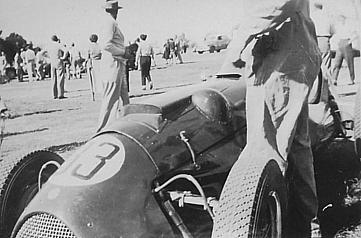
Melbourne-born, Lukey started racing relatively late, aged 32, having established and built Lukey Mufflers from its Nepean Highway, Highett base. Generations of enthusiasts are aware of his name because of the original equipment and performance exhausts and mufflers he produced. No lowered, worked EH Holden with wide chromies and twin SUs was complete without the distinctive Lukey logo being displayed on its exhausts for following traffic to know its performance intent.
Lukey started competition in the Victorian hills with a side-valve Ford Mainline Ute, Australia’s ubiquitous workhorse down the decades. It was in this car at the opening Altona meeting in 1954 that he frightened the life out of Stan Jones in Maybach when he spun whilst coming through The Esses, the car looking all the while as though it had lost its way transporting a load of mufflers from Highett to Williamstown. The competition regulator, the CAMS, frowned upon the use of such utilitarian vehicles in racing, so he switched to the first of a series of Ford Customlines.
At Coonabarabran, the Cusso was timed one way at 130mph, the car that weekend was festooned with masking tape, shields over its headlights, an enclosed radiator and sealed doors and boot to squeeze every bit of speed from the beast. Len had to enter the car through the windows; safety was again very much to the fore!
The car which ran at Coonabarabran was a new shell, but all the learnings and good bits of the earlier one were transferred across. Len raced it for a further year before being selling it to Melbourne driver Owen Bailey but it was badly damaged in an accident at Albert Park in 1958, Bailey’s first meeting in it.
1959 Australian Drivers Championship (ADC)
CAMS Gold Star Award
A name that came and conquered at Phillip Island before and after his victorious 1959 Australian Drivers Championship (ADC) / CAMS Gold Star Award was that of Melbourne based exhaust manufacturer and gifted racer, Len Lukey.
Determined and fiercely competitive, Lukey was one of only a few drivers who attempted to complete the grueling twelve race 1959 ADC schedule, at the time the longest in the championship's history. Lukey finished just two points ahead of his season long rival, Sydney based Alec Mildren and in third was Stan Jones, father of 1980 Formula One World Champion Alan Jones. Mildren raced to three wins that season, Lukey, Jones and Bill Patterson each took two victories, with single wins going to Jack Brabham, Bib Stillwell and New Zealand racer Ross Jensen. Make no mistake, there was no margin for error with competitors of this calibre during that championship.
Lukey continued to race competitively throughout the 60's in a range of open wheelers and touring cars, all fitted with his own specially engineered high performance exhaust systems manufactured from his Melbourne factory. This constant motor racing test bed ensured that all Lukey high performance exhaust products were in a class of their own and Lukey Exhaust became the brand of choice for motoring enthusiasts and Australian automotive repairers.
Len Lukey's special link to Phillip Island would continue during and well beyond his successful motor racing career. The running of the 1962 Armstrong 500 saw extensive track damage take place on the Victorian circuit and the Phillip Island Auto Racing Club (PIARC) could not afford to make the necessary repairs. The track then sat idle for two years. In 1964, Lukey bought the circuit and its surrounding property for $40,000, which was a massive amount of money back in those days. This investment provided a new lease of life to the majestic seaside circuit and the first public race meeting was held on the re-opened circuit three years later in September 1967.
Lukey passed away in 1978 still owning the circuit and it was purchased from Lukey's estate in 1984 for $800,000. In the decades to follow the popular Victorian motor racing venue grew to become an international standard Grand Prix circuit and one of the most popular motorcycle, sportscar, open wheeler and V8 Supercar circuits on this side of the world. |